
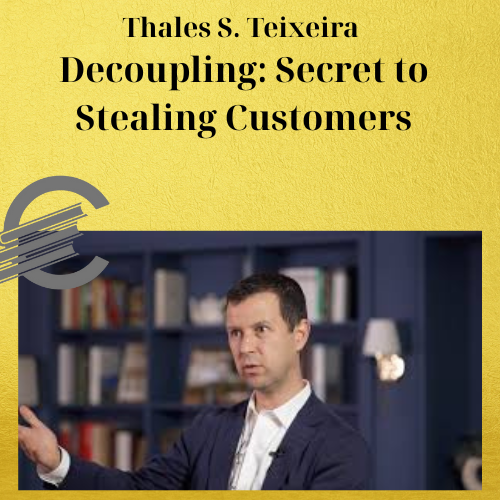
Thales S. Teixeira – Decoupling: Secret to Stealing Customers


Original price was: 224 $.25 $Current price is: 25 $.
 PayPal
 Crypto
 Credit Card
📦 Delivery Method: Instant Download (Mega.nz, GG Drive,...)
📩 For more information and support, contact us via email: saras.coursesbetter@gmail.com
Proof Download
Here’s What You Get:
Core Concept: What Is “Decoupling”?
Thales S. Teixeira – Decoupling: Secret to Stealing Customers refers to the strategic practice of breaking apart the traditional customer value chain—the sequence of activities customers go through from discovering a product/service to buying and using it—and targeting specific parts of it instead of trying to replicate the full experience of an incumbent company. This allows new digital entrants to:
-
Steal customer activities, not just customers themselves.
-
Focus on one part of the experience where incumbents are weak (e.g., convenience, ease of use).
-
Deliver superior value in one link of the chain rather than replicating the entire chain.
Why Decoupling Matters
Traditional competition often tries to match incumbents head-on across all their services. Decoupling instead:
-
Unlinks activities that were previously bundled by established players.
-
Identifies where customer dissatisfaction is highest and attacks that specific point.
-
Allows startups to enter markets with lower risk and cost.
For instance:
-
Uber didn’t create cars or hotels—it simply took mobility and made access to rides easier than traditional taxis.
-
Airbnb didn’t build hotels—it matched hosts with travelers.
-
Birchbox didn’t compete with Sephora stores; it solved the sampling and discovery experience.
The Customer Value Chain (CVC)
Teixeira’s framework centers around understanding the structure of the customer experience:
Decoupling Steps
-
Map the Customer Value Chain — chart all stages from discovery to use.
-
Classify Activities into:
-
Value-creating (meet core needs),
-
Value-capturing (how money/profit is made),
-
Value-eroding (adds effort or cost with little benefit).
-
-
Identify Weak Links where incumbents are poor.
-
Decouple by delivering superior performance on that link.
-
Optionally, scale by coupling back new activities later.
Startups that succeed do not out-spend incumbents; they specialize and simplify key customer-important tasks.
Strategic Implications for Businesses
For Startups & Disruptors
-
Focus on solving one key customer inefficiency extremely well.
-
Gain customers by making a specific part of the experience dramatically better.
For Established Companies
-
Recognize where you’re vulnerable in your value chain.
-
Consider decoupling defensively by improving or rethinking weak points before challengers do.
Underlying Research & Publication
The concept is most fully elaborated in the book Unlocking the Customer Value Chain: How Decoupling Drives Consumer Disruption by Thales S. Teixeira and Greg Piechota, based on 8 years of research into how digital startups disrupt traditional industries.
The book shows that:
-
Disruption is driven more by business model innovation than by technology alone.
-
Successful decoupling reduces monetary, time, or effort costs for customers.
-
Customers choose convenience and simplicity over legacy brand breadth when given better alternatives.
In Summary
| Aspect | Description |
|---|---|
| Decoupling | Breaking existing customer activity links to deliver superior value in one area. |
| Goal | Steal customer activity rather than just customers from incumbents. |
| Process | Map, identify weak links, specialize, then scale. |
| Value | Drives disruptive growth with less resource competition. |
| Framework Source | Teixeira’s Harvard-based research and book Unlocking the Customer Value Chain. |
See More: Insider.Group – Get $30k-$150k/m Pay Per Lead Clients Easily Even As A Beginner
Thales S. Teixeira – Decoupling: Secret to Stealing Customers
Name of course: Thales S. Teixeira – Decoupling: Secret to Stealing Customers
Delivery Method: Instant Download (Mega)
Contact for more details: saras.coursesbetter@gmail.com
Be the first to review “Thales S. Teixeira – Decoupling: Secret to Stealing Customers”
Related products





Reviews
There are no reviews yet.